Loop, Out-and-Back or Point-to-Point? Three Route Shapes
Choose a loop, out-and-back, or point-to-point bike route by matching its finish, transport, junctions, and options for shortening the ride to your plans.
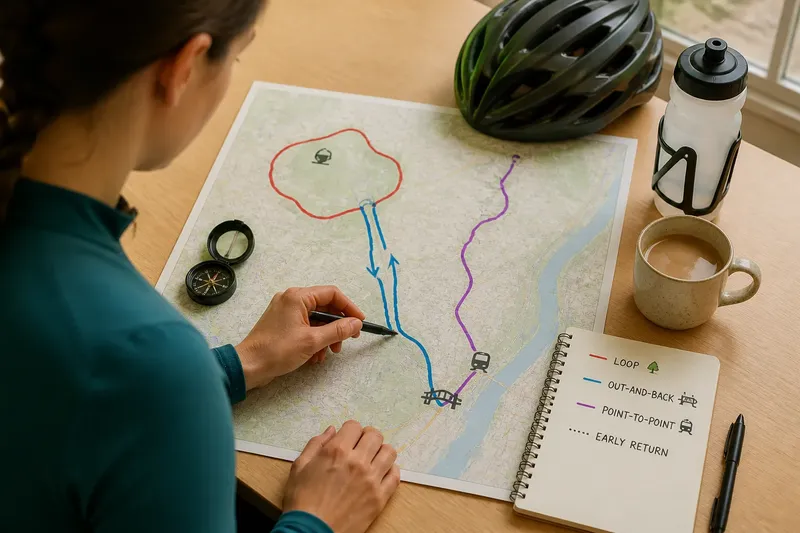
A bike route’s shape decides where you finish, what you need to arrange, and how easily you can change plans along the way. A loop route returns to its start, an out-and-back retraces its path, and a point-to-point ride ends elsewhere. Choose among them by checking the day’s real constraints—not just the line on the map.
What does each route shape ask of you?
Loop: Start and finish in the same place, following a circuit instead of returning over the same stretch. The main planning challenge is the connection that closes the circuit: a gap, awkward crossing, or bicycle-restricted path can turn a neat map outline into a poor ride.
Out-and-back: Ride to a chosen turnaround, then return along the same route. You can set a clear endpoint and use a familiar way home, but wind, slopes, traffic, and sightlines may feel different on the return.
Point-to-point: Start in one place and finish in another. This can let you follow a corridor in one direction, but you need a workable plan for getting yourself and your bicycle onward or home.
Check the actual route line, including junctions and access points. A path that appears connected on a map may end at a difficult crossing or have rules that do not permit bicycles.
When does a loop make the day easier?
A loop fits when you need to return to a reliable base such as home, a campsite, a station, or a parking area. It can also be a good choice when you want to vary the scenery without arranging a pickup.
Focus on the circuit’s least obvious link. Check that connecting roads and paths are open to bicycles, and inspect confusing junctions with a street-level map or local route map. If the connection feels unsuitable, redraw the loop rather than assuming you can sort it out on the ride.
Say you start at a town park, want to stop at a riverside café, and must finish back at the park. You trace a riverside path outward and quieter streets back, then notice on the map that the paths meet at a junction with no clear bicycle access. You replace that link with a nearby street shown as open to bicycles; the resulting plan keeps the park start and finish while making the connection explicit.
Before leaving, mark a shorter way back to your start. If your pace, energy, or the weather changes, you will have a defined alternative instead of needing to improvise.
Why choose an out-and-back?
An out-and-back works well when a useful road or trail leads to a recognizable destination, such as a bridge, village, or viewpoint. A single turnaround can make the route easier to follow than a circuit with several unfamiliar turns.
Choose a turnaround that is easy to identify from either direction and has a sensible place to pause. Treat it as a decision point, not a fixed obligation: if conditions or energy change, turn around earlier. Note crossings and surface changes on the outward leg, since they may require more attention when you approach from the opposite direction.
Do not assume the return will feel like a replay. A headwind, grade, traffic flow, or limited sightline can change how a familiar section rides. Leave room in your plan for the second half to call for a different pace or more attention.
What must you arrange for a point-to-point ride?
Settle how you will leave the finish before committing to the route. Options include transit that accepts bicycles, a pickup, or an overnight stay that lets you continue another day. Check bicycle rules, schedules, and the exact station or pickup location rather than relying on a nearby symbol on the map.
Check what is available at or near the endpoint, including food, water, shelter, and onward transport. If the finish is beyond a town or near a trail junction, confirm that you can reach those services from the actual route.
A point-to-point ride suits a destination-focused day, but its tradeoff is coordination. If transit does not carry your bicycle or the pickup plan falls through, you may need a different endpoint or a route that returns to the start.
How can you choose a bike route shape?
Start with what cannot change: where you need to finish, whether transport is available, and how much room you want to leave for an early return. Then check the route’s connections and possible stopping points.
- Check the finish requirement: If you must return to the start and have a clear circuit, choose a loop; if not, consider an out-and-back.
- Check the corridor: If a trail or road is suitable in both directions and has a recognizable turnaround, choose an out-and-back; if the return would be unsuitable, find another shape.
- Check the destination transport: If bicycle access and the return schedule are confirmed, point-to-point remains an option; if either is unclear, choose a route that returns to your start.
- Check the loop’s connecting junctions: If every link is open and usable by bicycle, keep the loop; if one is uncertain, inspect another connection or change the route.
- Check the early-return option: If a shorter route back is clear, keep it as a backup; if none exists and conditions are uncertain, choose a route with an easier exit.
- Check the endpoint: If you can safely reach a place to pause or continue your journey, keep the planned finish; if not, move the endpoint to an accessible location.
Distance alone will not settle the choice. A short route with difficult crossings or no useful exit can be harder to manage than a longer ride with clear junctions and places to pause.
Which route-shape questions matter most?
Is a loop better than an out-and-back?
A loop changes the scenery while returning you to the start, but it depends on a usable connection between its sides. An out-and-back gives you a clear destination and route home, so choose based on the path and junctions available.
How do I choose a turnaround point?
Pick a recognizable place with room to pause, such as a bridge or public rest area. If the route offers no safe or clear stopping point, select a different destination or plan to turn around earlier.
How do I plan transport for a point-to-point ride?
Confirm how you and your bicycle will leave the finish before setting out: check transit rules and schedules, arrange a pickup, or plan an overnight stay. If the endpoint is merely close to a station but not connected by a usable route, choose another finish.
Can a ride combine different route shapes?
Yes. You might follow an out-and-back trail before joining a loop through town, or finish point-to-point after a short circuit. Mark the junction where the route changes shape so you can follow the branch that leads to the intended finish.
What should you check before leaving?
Trace the start, connecting junctions, turnaround or finish, and return plan on your map. Save the route for offline access if reception may be limited, and identify an alternate path in case a closure or unsuitable connection changes the plan.
For a quick decision, search for a bike route shape that fits your finish first, then check the connection or transport that makes it workable. A loop, out-and-back, or point-to-point route is only as practical as its least clear junction and its plan for getting you where you need to end up.